I Quit Mandarin Six Years Ago. China’s AI Rise Brought Me Back.


There is a reflex in Western technology commentary that I have started to find embarrassing to watch. A Chinese lab ships something significant, and within a day the response has sorted itself into one of three bins: it was distilled from somebody else's model, it is a state propaganda instrument, or the benchmarks are cooked. Occasionally one of those is even true. But the reflex arrives before the evidence does, reliably, and I have watched enough engineers I respect perform it that I no longer think it is analysis. It is a way of not having to update.
I want to be careful, because the opposite reflex is just as lazy, and I have no interest in becoming the guy who mistakes a state's press release for a gift. The government funding this openness runs the most sophisticated censorship apparatus in the world. The same labs preaching from the podium in Shanghai have reportedly kept their strongest systems away from overseas users. Anyone who reads a keynote about inclusive global governance and hears only generosity is not paying attention either. Both things are true, and holding them at once is the entire job.
I build and evaluate multi-agent systems for a living, and I do it from Casablanca 🇲🇦, which turns out to matter for how this reads.
So, the confession this has been building towards. In early 2020 I had passed HSK 2 (汉语水平考试) and was a few weeks from sitting HSK 3. Then the test centres closed, the world rearranged itself, and Mandarin went into the category of things I would get back to. It stayed there for six years, and if I am honest about why, it is because somewhere underneath I had filed it as enrichment. A nice thing to have. Not load-bearing.
That was a judgement about where the interesting work would be made, and I made it wrong. Not wrong in some dramatic reversal, just quietly wrong in the way you only notice years later, when the field you work in has half its centre of gravity somewhere you can only reach through translation and other people's summaries. I read this stuff downstream of whoever decided which parts were worth rendering into English, and I have no way to audit that. For someone whose actual job is evaluating systems for the failures nobody thought to test for, that is a slightly humiliating position to be standing in.
Here is the week that prompted all this. On July 16, Moonshot AI released Kimi K3 🇨🇳, a 2.8-trillion-parameter sparse mixture-of-experts model. It placed second on Artificial Analysis’s AA-Briefcase benchmark, behind Claude Fable 5. The following morning Xi Jinping opened the World AI Conference in Shanghai in person, his first appearance there since the conference began in 2018, and announced the World Artificial Intelligence Cooperation Organization, five thousand AI training places for developing countries, cooperation centres with ASEAN, the African Union, the Arab League, CELAC, the SCO and BRICS, and a weather warning system offered to thirty countries. A record model release and a head of state, back to back, aimed at the same audience. Whatever else that is, it is deliberate scheduling.
Now, the word that is doing the most work in all of this coverage, and doing it dishonestly in several directions at once, is open.
An open-weight model means you get the trained parameters. You can download them, run them on hardware you control, fine-tune them for your own purposes, and nobody can revoke that afterwards. What you may not get is the training data, the training code, or a licence that permits every use. An open-source model, in the sense the Open Source Initiative has spent years trying to pin down for AI, means all of that plus enough code and data information that somebody else could genuinely study and rebuild the thing. The distance between those two is not pedantry. It is the difference between being handed a tool and being handed the means of production.
Kimi K3 was called open-weight and open-source by people who should know better. At the July 16 announcement there were no downloadable weights, model card, or licence file. As this article went to publication on July 27, Moonshot’s official Hugging Face page was still counting down to the release later that day. For eleven days, the largest announced open model in the world was an API and a promise, and the press repeated the adjective anyway.
I am not interested in that as a gotcha. I am interested in it because of who pays for the imprecision. If you are in San Francisco, the difference between open-weight and open-source is a licensing footnote, since either way you have capital, compute, and three frontier labs within driving distance. If you are building anything serious in Morocco, or Kenya, or Vietnam, that footnote is the whole thing. Open weights mean a model you can run on your own hardware, audit for your own languages, fine-tune on data you are not permitted to send abroad, and keep running when the geopolitics turn. It is the difference between owning infrastructure and renting intelligence from somebody who can raise your prices or cut you off. So when a Chinese lab publishes weights and an American lab publishes an API with a waiting list, it does not particularly matter to me which one is more virtuous. One of them changes what I am able to build.
Which is exactly the calculation Xi was making from that stage, and it would be naive not to say so plainly. Five thousand training places and a cooperation centre with the Arab League are not charity. They are the standard opening move of a country that intends to be the default substrate the next generation of developers builds on, in the same way American software became the default substrate for mine. Commoditise the layer where your rival makes his money, give the tools away, and collect the dependency later. It is an old move and it works, and the correct response to it from where I sit is neither applause nor suspicion but attention.
Because underneath the models there is something harder to dismiss than any single release. China's share of global AI publications went from under five percent in 2000 to roughly thirty-six percent by 2025.
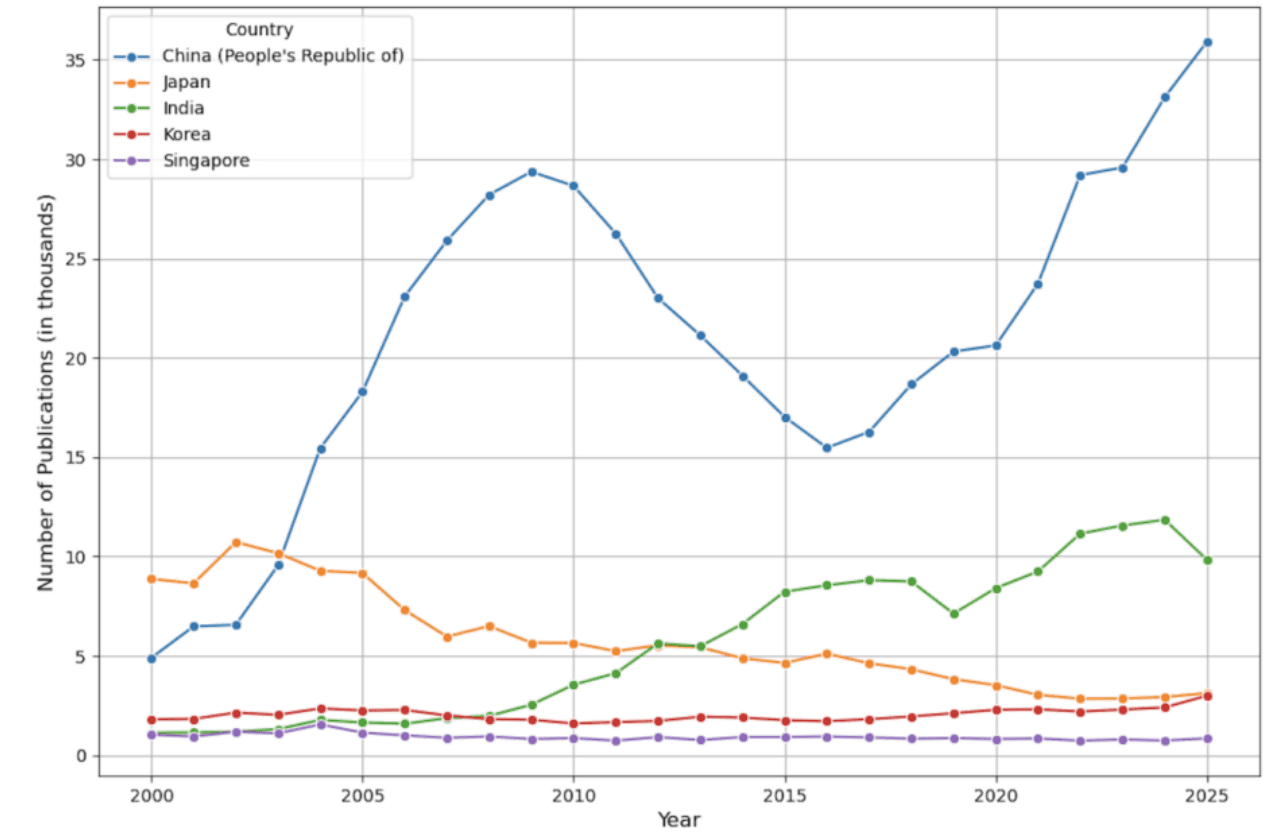
Figure 2. Share of global AI publications across selected Asian countries, 2000–2025. The source paper treats 2025 data as provisional.
By one analysis of the Dimensions database it now publishes about as much AI research as the United States, the United Kingdom and the EU-27 put together, and took over forty percent of global AI citations in 2024.
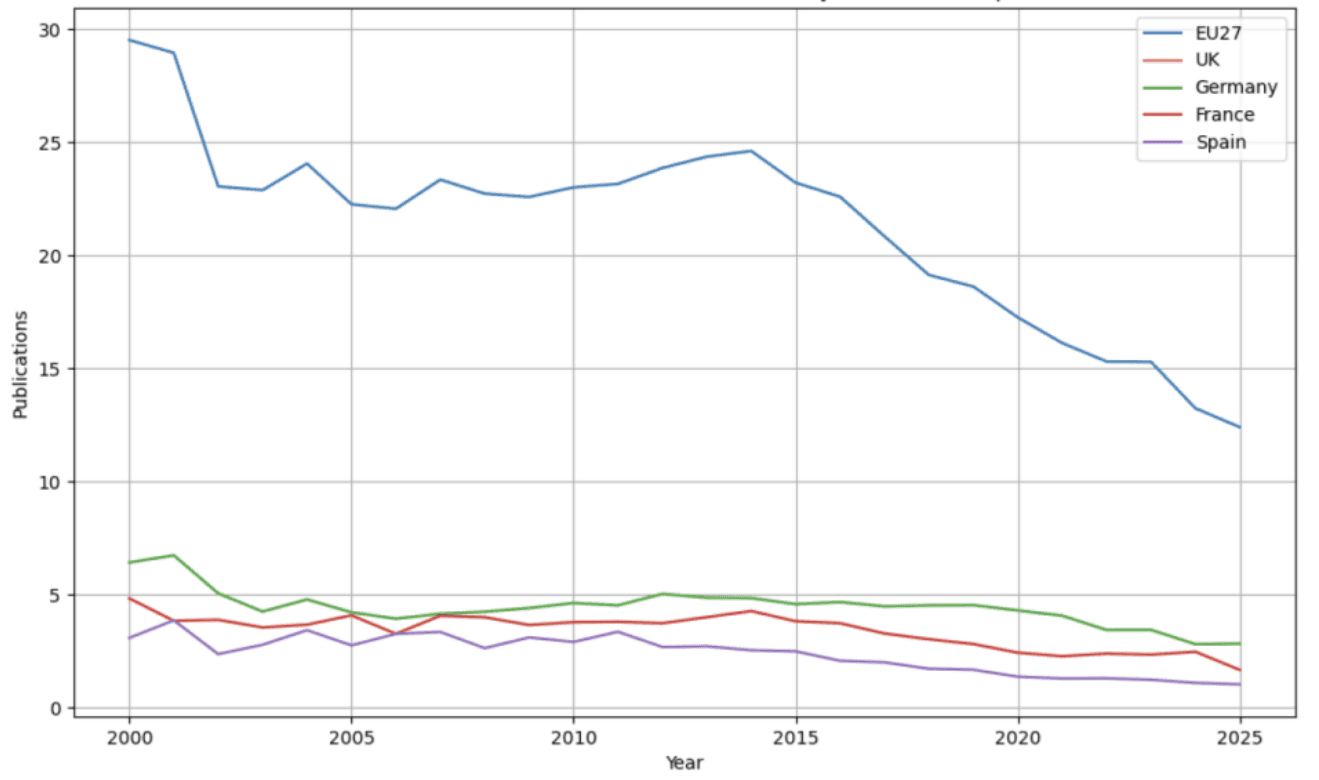
Figure 1. Share of global AI publications across selected European countries, 2000–2025. Source: arXiv:2509.25298.
The usual consolation is that this is quantity rather than quality, and there is still something to it, since American work still outnumbers Chinese work inside the hundred most cited papers, fifty to thirty-four as of 2023.
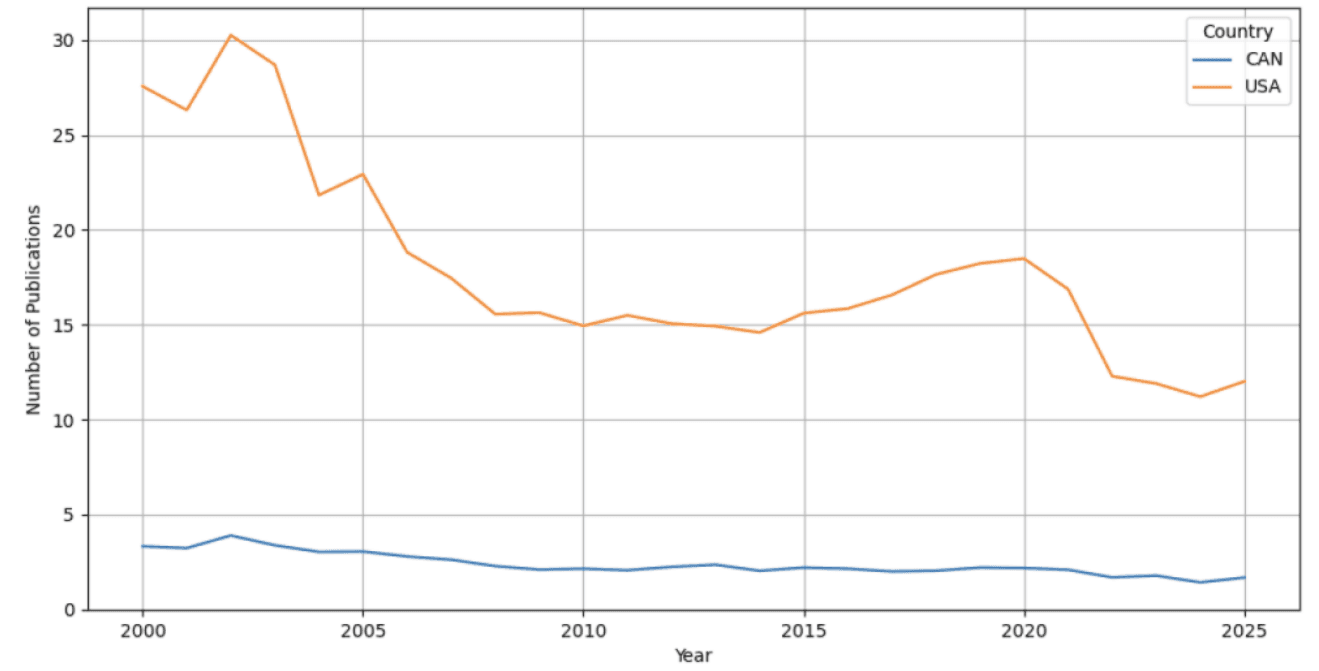
Figure 3. Share of global AI publications across selected North American countries, 2000–2025. Source: arXiv:2509.25298.
But that is a thin ledge to stand on, it narrows every year, and on citation share overall the crossover already happened while people were still arguing about whether it would.
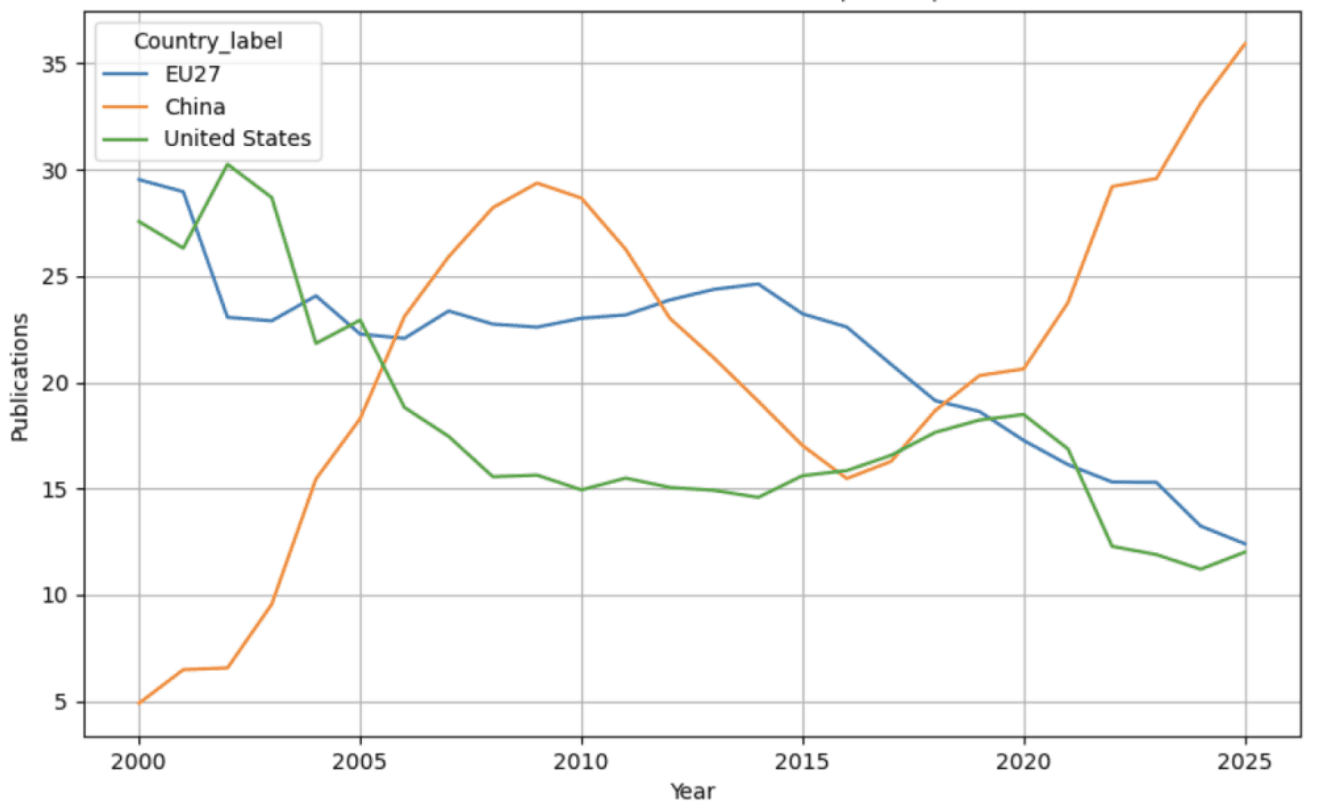
Figure 5. Share of global AI publications for China, the United States, and EU27, 2000–2025. Source: arXiv:2509.25298.
A remarkable amount of current AI research is available as preprints, free, tonight. If you are doing a doctorate anywhere in the world, a vast body of current AI research is a search box away and costs nothing. That is the part of this story that deserves more enthusiasm than it gets.
This is an argument about my own bet, made from a country that both blocs are currently pitching to, in a field where I would rather read the primary source than the summary of the summary. HSK 2 gets you lunch and street signs. HSK 3 and 4 get you far enough to begin working through a policy document in the original with reference tools, and to start hearing the difference between what is said for the room and what is said for the record.
HSK 3 by December. HSK 4 by the end of next year. Ask me about it in a year, and please do, because the drawer is very comfortable and I have already lost six years to it once. 📚
Sources, if you want to check any of this rather than take my word for it: the arXiv study on global AI publication trajectories from 2000 to 2025 (arxiv.org/abs/2509.25298), Science on Chinese AI output overtaking the US, UK and EU combined (science.org), MIT Technology Review on the state of the race (technologyreview.com), the Open Source Initiative's Open Source AI Definition (opensource.org/ai), Moonshot's K3 announcement (kimi.com), and official coverage of the 2026 World AI Conference (scio.gov.cn).
Share this article
Send it to someone who would use the context.
Add your perspective
The thread is stored in GitHub Discussions through Giscus, so the conversation stays portable, moderated on GitHub, and visually aligned with this site.
Loading comments connects to GitHub and may use third-party storage in your browser.